
Ai tools
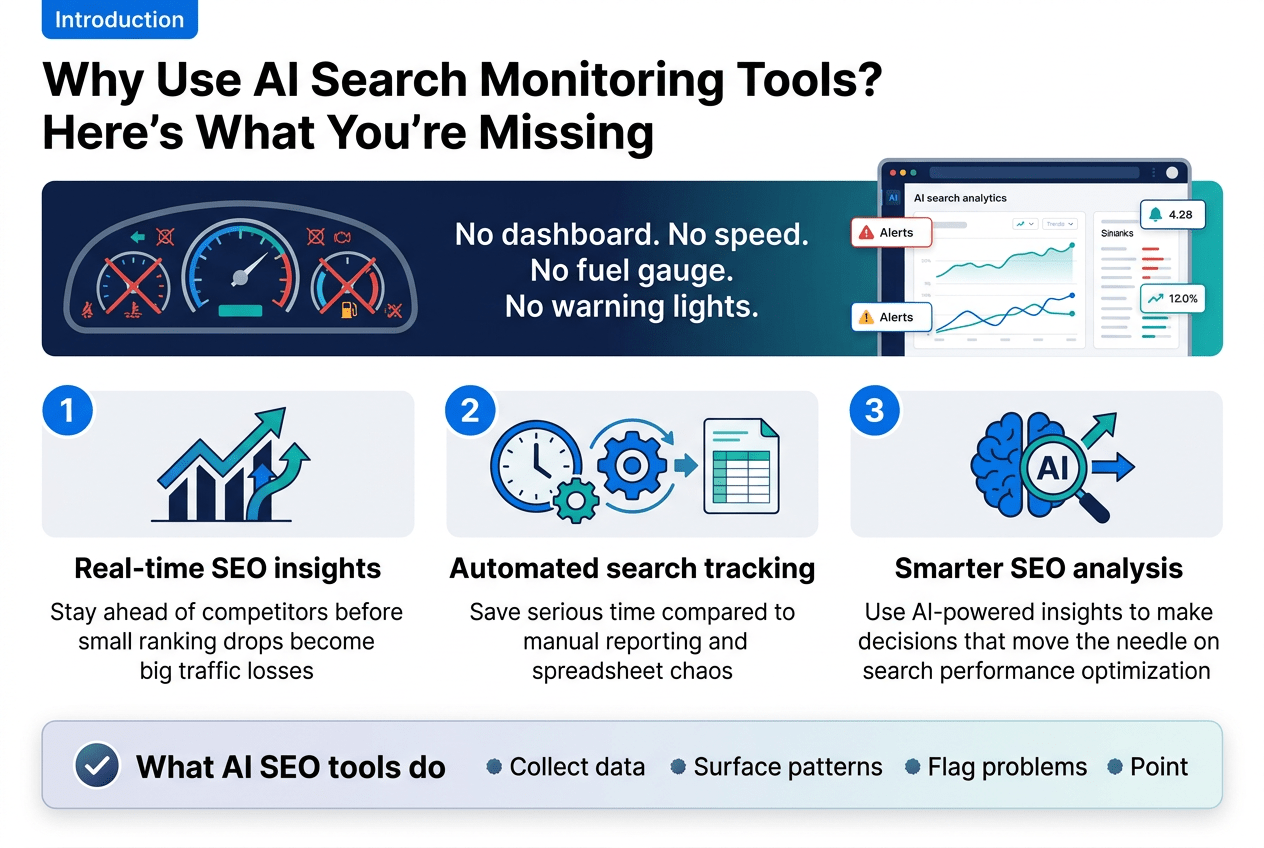
Why Use AI Search Monitoring Tools? Here’s What You’re Missing

Why Use AI Search Monitoring Tools? Here’s What You’re Missing
Use AI search monitoring tools to track performance, improve visibility, and grow your online presence with smart insights.”
This guide is for digital marketers, SEO managers, and business owners who want to stop guessing and start making moves backed by real data.
Here’s what we’ll cover:
- How real-time SEO insights keep you ahead of competitors before small ranking drops turn into big traffic losses
- Why automated search tracking saves your team serious time compared to manual reporting and spreadsheet chaos
- How AI-powered SEO analysis helps you make smarter decisions that actually move the needle on search performance optimization
By the end of this guide, you’ll know exactly what these tools do, why they matter, and how to improve search ROI by picking the right one for your setup.
Understanding AI Search Monitoring Tools
What AI Search Monitoring Tools Actually Do
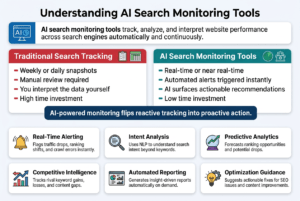
AI search monitoring tools are software platforms that track, analyze, and interpret how your website performs across search engines — automatically and continuously. Instead of manually pulling rank reports or digging through spreadsheets, these tools do the heavy lifting for you by collecting data around the clock and surfacing what actually matters.
At their core, AI search monitoring tools connect to search engine data sources (Google Search Console, Bing Webmaster Tools, third-party crawlers, etc.) and layer machine learning on top of that raw data. This means they don’t just tell you what happened — they help you understand why it happened and what you should do next.
Here’s what they typically handle day-to-day:
- Keyword rank tracking — monitoring where your pages show up for target search terms, across devices and locations
- Visibility scoring — calculating your overall presence in search results compared to competitors
- Traffic anomaly detection — flagging sudden drops or spikes in organic traffic before they spiral into bigger problems
- SERP feature monitoring — tracking whether you’re winning or losing featured snippets, People Also Ask boxes, and other rich results
- Competitor benchmarking — keeping an eye on how rival websites move up or down for shared keywords
- Algorithm change alerts — notifying you when a Google core update or algorithm shift may have impacted your rankings
The AI component goes beyond simple data collection. These tools use pattern recognition to spot trends you’d likely miss in a standard dashboard, connecting dots between technical site issues, content changes, and ranking fluctuations in ways that traditional tools simply can’t do at scale.
How They Differ From Traditional Search Tracking Methods
Traditional search tracking was largely manual, reactive, and time-consuming. You’d schedule weekly rank checks, export CSV files, build your own comparison spreadsheets, and then try to make sense of what the numbers meant — usually days after something important already happened.
Here’s a side-by-side look at how the two approaches compare:
| Feature | Traditional Search Tracking | AI Search Monitoring Tools |
|---|---|---|
| Data collection frequency | Weekly or daily snapshots | Real-time or near real-time |
| Anomaly detection | Manual review required | Automated alerts triggered instantly |
| Insight generation | You interpret the data yourself | AI surfaces actionable recommendations |
| Competitor tracking | Limited, often manual | Continuous, automated benchmarking |
| Scalability | Gets harder as your site grows | Scales effortlessly with your keyword set |
| Algorithm change detection | Noticed after traffic drops | Flagged proactively as it unfolds |
| Time investment | High — requires regular manual effort | Low — monitoring runs in the background |
With traditional methods, by the time you noticed a ranking drop, you’d already lost traffic, leads, and revenue. The problem had been brewing for days, sometimes weeks, and you were only finding out because your monthly report finally landed in your inbox.
Automated search tracking
through AI-powered tools flips this entirely. You get notified the moment something shifts. Whether it’s a competitor overtaking your top keyword, a technical crawl issue dragging down a key page, or a content gap opening up in your niche — you know about it right away, while there’s still time to act.
Another major difference is the depth of analysis. Traditional tools give you raw numbers. AI-powered SEO analysis gives you context. Instead of just seeing that a keyword dropped from position 3 to position 11, you get a breakdown of what changed — whether it’s a content freshness issue, a backlink loss, a competitor gaining new links, or a shift in search intent that your current page doesn’t address anymore.
To Read more Aritcles this type Click Here
Real-Time Alerting and Anomaly Detection
One of the biggest advantages of AI-driven monitoring is that it doesn’t wait for you to go looking for problems. The system continuously watches your data and sends alerts when something falls outside normal patterns — a traffic drop, a ranking shift, a crawl error spiking across multiple pages.
Natural Language Processing for Search Intent Analysis
Modern AI search analytics tools can analyze the language patterns behind search queries, helping you understand whether your content aligns with what searchers actually want. This goes beyond matching keywords — it’s about understanding whether your page satisfies the intent behind a search, which is increasingly what Google rewards.
Predictive Analytics
By analyzing historical patterns, seasonal trends, and competitor movements, they can predict ranking opportunities and potential drops before they show up in your data.
Competitive Intelligence
Strong keyword monitoring tools include competitor tracking built right in. This kind of competitive visibility used to require hours of manual research every week.
Automated Reporting and Custom Dashboards
AI monitoring platforms typically offer customizable dashboards that pull together the metrics that matter most to your specific goals — whether that’s local search visibility, e-commerce product page rankings, or content hub performance. Automated reporting means your team stays aligned without anyone having to manually compile data.
Integration With the Broader SEO Ecosystem
The most capable platforms connect with tools you’re already using — Google Analytics, Google Search Console, CMS platforms, CRM systems, and technical SEO crawlers. This connected data environment is what makes search performance optimization possible at scale, giving you a unified picture of how every piece of your digital presence fits together.
Scalable Keyword Tracking
Whether you’re monitoring 50 keywords or 50,000, AI-powered tools handle the volume without breaking a sweat. This scalability is critical for large sites, multi-location businesses, or agencies managing multiple clients — scenarios where manual tracking simply falls.
Stay Ahead With Real-Time Search Insights
Catch Ranking Changes Before They Hurt Your Traffic
Ranking drops rarely announce themselves in advance. One day you’re sitting comfortably on page one, and the next, your traffic has taken a nosedive — and you’re left scrambling to figure out what happened. This is where real-time SEO insights from AI search monitoring tools completely change the game.
Traditional rank tracking tools often update once a day, or even less frequently. By the time you notice a ranking shift, you may have already lost days’ worth of clicks, leads, and revenue. AI search monitoring tools track changes as they happen, sending you alerts the moment a keyword moves — whether it’s a small dip or a significant drop off the first page.
Here’s what real-time ranking monitoring actually helps you do:
- Spot pattern-based drops — Identify whether a ranking change affects a single page or an entire content cluster, helping you pinpoint the root cause faster.
- Protect high-converting pages — Pages that drive leads or sales deserve the closest watch. Automated alerts mean you’re always the first to know when they’re under threat.
- Reduce revenue loss windows — The faster you detect a drop, the faster you can act, and the less traffic you lose overall.
Think of it like a smoke detector for your search visibility. You don’t want to find out about a fire the next morning — you want to know the second something starts burning.
Monitor Competitor Movements as They Happen
Your competitors aren’t standing still, and neither is the search landscape. Rivals launch new content, build backlinks, target fresh keywords, and run campaigns — sometimes overnight. If you’re only checking in on the competition once a week or once a month, you’re playing catch-up by default.
To Read more Aritcles this type Click Here
AI search analytics tools give you a live view into how competitors are moving across the search results pages (SERPs). Instead of relying on manual checks or delayed reports, you get a continuous feed of competitive intelligence that helps you stay a step ahead.
Here’s what competitor monitoring in real time actually looks like:
| What You Can Track | Why It Matters |
|---|---|
| New keyword rankings by competitors | Spot gaps and opportunities before they gain momentum |
| Content published targeting your keywords | Understand what you’re up against before they outrank you |
| SERP feature acquisitions | Know when a competitor grabs a featured snippet or PAA box |
| Ranking velocity | See how fast a competitor is climbing on specific queries |
| Traffic share shifts | Gauge whether you’re gaining or losing ground in your niche |
When a competitor suddenly starts ranking for a high-value keyword you’ve been targeting, you want to know about it right away — not three weeks later when they’ve already built authority and social signals around that content.
Real-time competitor tracking through search monitoring software also helps you reverse-engineer what’s working. If a rival’s page jumps from position 15 to position 3, that’s a signal worth investigating. Did they refresh the content? Earn new backlinks? Change their page structure? The sooner you know, the sooner you can apply similar tactics or counter with something stronger.
React Faster to Algorithm Updates
Google rolls out thousands of algorithm changes every year — some minor tweaks, others major updates that can shake entire industries. The challenge isn’t just surviving these updates; it’s knowing when one has hit and understanding its impact quickly enough to respond effectively.
Automated search tracking through AI-powered tools gives you a clear advantage here. Instead of waiting for Google to officially announce a core update — which can sometimes take days or even weeks — you can spot the signals yourself through sudden, widespread ranking fluctuations across your keyword set.
Here’s how AI search monitoring tools help you react smarter to algorithm shifts:
- Identify update timing accurately — When you see a cluster of ranking changes across multiple pages on the same day, that’s a signal. AI tools can cross-reference this against industry-wide volatility data to confirm whether an algorithm update is in play.
- Segment your affected pages — Not every page will be hit equally. Real-time data helps you quickly identify which content categories, page types, or topic areas took the hardest hit.
- Run faster diagnostics — With AI-powered SEO analysis, you can compare pre- and post-update performance side by side, helping you build a clearer picture of what the algorithm is now favoring.
- Test and iterate quickly — The faster you understand what changed, the faster you can make adjustments, whether that means updating content, improving E-E-A-T signals, adjusting internal linking, or revisiting your on-page structure.
The damage is deeper, and the recovery takes longer. With real-time monitoring built into your workflow, you shorten that response window dramatically — and that speed difference can be the gap between a temporary dip and a long-term traffic decline.
Save Time and Resources With Automated Monitoring
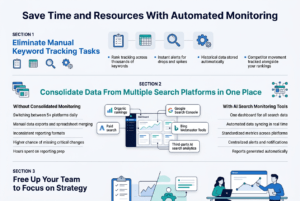
Eliminate Manual Keyword Tracking Tasks
Manually tracking keywords is one of those tasks that quietly eats up hours every week. You pull data, paste it into spreadsheets, check rankings one by one, and by the time you’re done, half the data is already outdated. Automated search tracking through AI search monitoring tools cuts all of that out.
Instead of logging into multiple platforms and running reports by hand, automated monitoring runs continuously in the background — collecting, processing, and flagging changes without you lifting a finger. Here’s what that looks like in practice:
- Rank tracking happens automatically across thousands of keywords, not just a handful you manually check
- Alerts notify you the moment a keyword drops or spikes, so you catch issues before they become expensive problems
- Historical data is stored and organized without you building custom tracking sheets from scratch
- Competitor movement gets tracked alongside your own rankings, giving you a complete picture without double the work
With keyword monitoring tools handling the repetitive data collection, your team stops wasting energy on tasks that a machine can do faster and more accurately. That shift alone changes what’s possible in a week’s work.
Consolidate Data From Multiple Search Platforms in One Place
One of the biggest headaches in SEO and search marketing is the data fragmentation problem. Your organic rankings live in one tool, paid search data sits in another, and Google Search Console, Bing Webmaster Tools, and third-party AI search analytics platforms each have their own dashboards. Piecing all of that together to form a clear picture takes serious time and leaves room for error.
Search monitoring software built on AI solves this by pulling data from multiple sources into a single, unified view. Here’s a quick comparison of what working without versus with consolidated monitoring actually looks like:
| Without Consolidated Monitoring | With AI Search Monitoring Tools |
|---|---|
| Switching between 5+ platforms daily | One dashboard for all search data |
| Manual data exports and spreadsheet merging | Automated data syncing in real time |
| Inconsistent reporting formats | Standardized metrics across platforms |
| Higher chance of missing critical changes | Centralized alerts and notifications |
| Hours spent on reporting prep | Reports generated automatically |
When you can see organic, paid, local, and mobile search performance side by side, patterns become obvious that you’d never catch when the data is scattered. You stop making decisions based on incomplete snapshots and start working from the full story.
The best AI SEO tools go even further by layering AI-powered SEO analysis on top of the consolidated data — identifying correlations, flagging anomalies, and surfacing insights you wouldn’t find just by eyeballing numbers in a spreadsheet.
Free Up Your Team to Focus on Strategy
Here’s the honest truth: your team’s most valuable output isn’t data collection — it’s strategic thinking. Every hour spent pulling reports, checking rankings manually, or reconciling data from different platforms is an hour not spent on content strategy, link building, technical SEO improvements, or campaign optimization.
AI search monitoring tools handle the grunt work so your team can operate at a higher level. When monitoring runs on autopilot, the work shifts from reactive and repetitive to proactive and creative.
Think about the kinds of things your team could be doing instead:
- Developing content strategies based on search trend data the tool has already surfaced
- Running A/B tests on title tags and meta descriptions with time freed from manual tracking
- Building link acquisition campaigns that target gaps the AI has already identified
- Refining audience targeting based on search intent insights pulled automatically
- Responding faster to algorithm changes because real-time alerts take the guesswork out of detection
Smaller teams benefit especially hard from this shift. When you don’t have the headcount to staff a dedicated analytics role, automated search tracking essentially fills that gap. The tool does the monitoring, the flagging, and the data organization — your people step in to act on what it finds.
Larger teams see a different kind of benefit: the ability to scale monitoring across bigger keyword sets, more markets, and multiple clients or business units without proportionally scaling headcount. Search performance optimization at scale is only realistic when the monitoring layer is automated.
The bottom line is that time is a finite resource, and the teams winning in search right now are the ones spending theirs on decisions, not data collection.
Make Smarter Decisions With AI-Powered Data Analysis
Identify High-Impact Keyword Opportunities Quickly
Digging through thousands of keywords manually is exhausting, and by the time you find a gem, someone else has already ranked for it.
Instead of spending hours in spreadsheets, AI-powered SEO analysis surfaces high-value keyword opportunities based on real performance signals — things like search volume trends, competition gaps, and ranking momentum. You get a prioritized list of keywords worth targeting right now, not a raw data dump that leaves you guessing.
Here’s what makes this genuinely useful:
- Gap detection — the AI spots keywords where competitors are ranking but you’re not, flagging them as quick-win opportunities
- Trend weighting — rising keywords get flagged before they peak, giving you a first-mover advantage
- Difficulty scoring — you can filter for high-impact, lower-competition keywords that actually move the needle without burning your entire content budget
- SERP feature analysis — the tools identify which keywords trigger featured snippets, People Also Ask boxes, or local packs, so you know exactly where to aim
This kind of targeted keyword discovery isn’t just faster — it’s smarter. You stop chasing keywords that look good on paper and start focusing on ones with a real shot at improving your search performance.
Understand Search Intent Trends More Accurately
Keywords alone don’t tell the whole story. Two people can search the same phrase and want completely different things. Ranking without understanding intent is like showing up to a party in the wrong outfit — technically present, but missing the mark entirely.
AI search analytics goes deeper than traditional keyword research by analyzing why people are searching, not just what they’re searching for. It reads patterns across millions of queries to categorize intent — informational, navigational, commercial, transactional — and tracks how those patterns shift over time.
For example:
- A query like “best project management software” might shift from informational to transactional as buyer behavior evolves
- Seasonal intent swings — like “gifts” leaning more transactional in November — get picked up automatically
- Emerging micro-intents (like “free alternatives to X” or “X vs Y”) surface before they become competitive
| Intent Type | What the User Wants | Content Match |
|---|---|---|
| Informational | Learn something | Blog posts, guides, FAQs |
| Navigational | Find a specific site | Branded landing pages |
| Commercial | Compare options | Reviews, comparisons |
| Transactional | Buy or sign up | Product pages, CTAs |
You start creating pages that match exactly what your audience needs at that moment — and that’s what drives real engagement.
Use Predictive Insights to Plan Content Ahead of Time
Reactive SEO is a constant game of catch-up. By the time you notice a trend, write about it, publish it, and wait for it to rank, the moment has passed. Predictive insights flip that script entirely.
The best AI SEO tools don’t just tell you what’s happening right now — they forecast what’s likely to happen next. Using historical search data, seasonal patterns, and trend modeling, they give you a heads-up weeks or even months before a topic peaks in search volume.
This means you can:
- Plan editorial calendars around upcoming demand spikes rather than scrambling to react when they hit
- Pre-publish content so it has time to build authority before the traffic surge arrives
- Allocate resources smarter — knowing which topics will trend lets you invest production effort where it’ll pay off most
- Avoid content that’s already past its peak, saving time and budget for topics with forward momentum
Think of it like a weather forecast for your content strategy. You wouldn’t leave home without checking the weather if you knew a storm was coming. Predictive search insights work the same way — they let you show up prepared instead of caught off guard.
This kind of forward-looking planning is where AI-powered SEO analysis delivers a compounding advantage. While competitors react to yesterday’s trends, you’re already ranking for tomorrow’s searches.
Turn Complex Data Into Actionable Recommendations
One of the biggest frustrations with SEO data is that there’s so much of it — and most of it means nothing without context. Traffic numbers, click-through rates, impression counts, ranking fluctuations — raw data piles up fast, and knowing what to actually do about it is a different skill entirely.
Here’s what that looks like in practice:
- Ranking drops get explained — instead of just flagging a drop from position 4 to position 11, the tool identifies whether it’s a content freshness issue, a competitor improvement, or a SERP layout change
- Content gaps become specific tasks — “You’re missing a section on X, which appears in 73% of top-ranking competitors’ pages”
- Quick wins get surfaced automatically — pages sitting on page 2 that need a small push get flagged as priority optimization targets
- Performance anomalies trigger alerts — so you’re never the last to know when something goes wrong
The difference between a data dashboard and a genuinely useful tool comes down to this: one shows you numbers, the other tells you what to do about them.
| Without AI Analysis | With AI-Powered Recommendations |
|---|---|
| Raw traffic data | Specific pages to optimize |
| Keyword rank lists | Prioritized action items |
| Trend graphs | Predicted opportunities with timing |
| Competitor data | Exact gaps to close |
When keyword monitoring tools go beyond data collection and into actual decision support, your team spends less time analyzing and more time executing. That’s how you improve search ROI without burning out your SEO team.
Boost Your Search Performance and ROI
Improve Organic Rankings Through Continuous Optimization
AI search monitoring tools make continuous optimization possible by tracking how your pages perform across hundreds of keywords simultaneously, flagging drops before they turn into serious losses, and surfacing opportunities you might have otherwise missed.
- Keyword drift detection — AI-powered SEO analysis spots when a page that ranked for a high-value term starts sliding, so you can act fast instead of discovering the problem weeks later during a monthly review.
- Content gap identification — The tools compare your rankings against competitors and highlight keyword clusters where rivals are gaining ground, giving you a clear roadmap for where to focus your content efforts next.
- On-page signal monitoring — Search performance optimization tools track technical factors like page speed, Core Web Vitals, and crawl errors in real time, connecting those signals directly to ranking changes so you know what’s actually moving the needle.
- SERP feature tracking — Beyond standard rankings, AI search analytics monitor your presence in featured snippets, People Also Ask boxes, and local packs — all of which contribute to visibility and traffic.
The compounding effect here is significant. Small, consistent improvements guided by real-time SEO insights add up to meaningful ranking gains over time, especially in competitive niches where a single position change can represent thousands of monthly visits.
Increase Click-Through Rates With Better Search Visibility
Ranking higher is only half the battle. If people scroll past your listing without clicking, that traffic never arrives. AI search monitoring tools help you close that gap by connecting ranking data with actual click-through rate (CTR) performance, so you can see exactly where impressions aren’t converting into visits.
What Drives CTR Improvements
| Factor | How AI Monitoring Helps |
|---|---|
| Title tag performance | Compares CTR across pages to identify underperforming titles that need rewriting |
| Meta description effectiveness | Tracks whether description copy changes lead to measurable CTR lifts |
| Rich result eligibility | Flags pages that qualify for schema markup enhancements to stand out in SERPs |
| Position vs. CTR gap | Identifies pages ranking in the top 5 but with below-average CTR, signaling a relevance mismatch |
| Brand vs. non-brand queries | Breaks down CTR by query type so you can tailor messaging for different search intents |
When you pair search monitoring software with CTR data from Google Search Console, patterns become much clearer. You might discover that one category of pages consistently underperforms on CTR despite strong rankings — and a few title tag experiments, guided by the data, can turn that into a significant traffic boost without moving up a single position.
Better search visibility also comes from owning more real estate on the results page. AI search analytics track your presence across:
- Image and video packs — Visual results that draw clicks for certain query types
- Knowledge panels — Especially valuable for brand-related searches
Automated search tracking across all these formats means you always know where you stand and where quick wins are available.
Measure the Direct Impact on Revenue and Lead Generation
At the end of the day, search performance needs to connect to business outcomes, not just traffic metrics. This is where a lot of traditional SEO reporting falls short — it tells you rankings went up but can’t tell you whether that translated into more leads or revenue. The best AI SEO tools bridge that gap.
Connecting Search Data to Business Metrics
Modern AI search monitoring platforms can integrate with your analytics stack to tie ranking and visibility changes directly to conversions.
- Which keyword rankings are actually driving form submissions or purchases?
- When a competitor pushed us down two positions on a high-intent keyword, how much revenue did we lose?
- Which pages generate the most qualified leads relative to their traffic volume?
This kind of analysis transforms search monitoring from a purely tactical function into a strategic business tool.
Practical Ways to Measure Search ROI
1. Revenue attribution by keyword cluster
Group your target keywords by intent (informational, navigational, transactional) and track conversion rates separately for each cluster. This shows you exactly where to invest resources for maximum return.
2. Rank-to-revenue modeling
By combining historical ranking data with conversion and revenue data, AI-powered SEO analysis tools can model the expected revenue impact of moving from position 8 to position 3 on a specific term — before you invest in content or link building.
3. Competitive loss tracking
When a competitor outranks you on a high-value keyword, you can estimate the traffic and revenue opportunity you’re missing. That figure makes a compelling internal business case for increased SEO investment.
4. Lead quality scoring by search source
Not all organic traffic is equal. Tracking which keywords and pages generate leads that actually close at higher rates helps you prioritize the right search opportunities — not just the ones with the highest search volume.
Key Factors to Evaluate Before Committing to a Tool
Picking the right AI search monitoring tool is a big decision, and rushing into it can cost you time, money, and a lot of frustration. Before you sign any contracts or hand over your credit card, here are the factors that actually matter:
- Data Coverage and Sources: Does the tool pull data from Google, Bing, YouTube, and other search engines relevant to your business? A tool that only monitors one platform might leave you with blind spots.
- Update Frequency: Real-time SEO insights are only valuable if the data is actually fresh. Check whether the tool updates hourly, daily, or in real time — and make sure that cadence matches your needs.
- Keyword Monitoring Depth: How many keywords can you track? Does it support long-tail keywords, local search terms, and branded queries? The best AI SEO tools give you granular control here.
- Integration Capabilities: Your search monitoring software should play nicely with your existing stack — Google Analytics, Search Console, CRM platforms, and reporting dashboards.
- Ease of Use: A tool with a steep learning curve will sit unused. Look for clean dashboards, intuitive navigation, and digestible reports that your whole team can work with.
- Pricing Transparency: Watch out for hidden fees tied to keyword limits, user seats, or data exports. Understand exactly what you’re paying for before committing.
- Customer Support Quality: When something breaks or you need help interpreting data, responsive support is non-negotiable.
| Factor | Why It Matters |
|---|---|
| Data Coverage | Ensures no channel goes unmonitored |
| Update Frequency | Keeps your decisions based on current reality |
| Keyword Depth | Captures full search landscape, not just surface-level terms |
| Integrations | Reduces manual work and data silos |
| Ease of Use | Drives adoption across your team |
| Pricing Clarity | Prevents budget surprises |
| Support Quality | Keeps you moving when issues arise |
Questions to Ask During a Product Demo
Product demos are often polished and perfectly staged. Your job is to cut through the rehearsed presentation and get to the truth. Here are the questions that will actually reveal how useful a tool will be in practice:
About the Data:
- Where does your data come from, and how often is it refreshed?
- How do you handle data discrepancies between your platform and Google Search Console?
- What’s your data retention policy — how far back can I pull historical search performance data?
About the Features:
- Can you show me how AI-powered SEO analysis works in a real scenario, not a demo dataset?
- How does your automated search tracking handle algorithm updates and ranking volatility?
- What kind of alerts can I set up, and how customizable are they?
About the Team Experience:
- How many users can access the platform, and are there role-based permissions?
- What does the onboarding process look like, and how long does it typically take to get up and running?
About Support and Reliability:
- Do you have documented uptime guarantees or SLA commitments?
- What happens to my data if I decide to cancel?
About Competitors:
- How does your tool differ from [specific competitor]?
- Which types of businesses get the most value from your platform?
Pay close attention to how the sales rep handles questions they weren’t expecting. Vague answers or deflection around data accuracy and support responsiveness are red flags worth taking seriously.
Signs a Tool Will Scale With Your Business Growth
A tool that works great for a 10-person team shouldn’t fall apart when you double in size or expand into new markets. Here’s how to spot a platform built for growth before you’re locked into a long-term contract:
Flexible Keyword and Project Limits
Look for tools that offer tiered plans with expandable keyword tracking capacity. If you’re currently monitoring 500 keywords but expect to grow to 5,000 within a year, you need a platform where that upgrade is seamless — not one that requires migrating to an entirely new system.
Multi-User and Multi-Team Support
As your organization grows, more people will need access to AI search analytics — marketers, content teams, executives, and agency partners. A scalable tool supports multiple users with customized permission levels and collaborative features.
Multi-Location and Multi-Language Capability
If your business is expanding geographically, your search monitoring software needs to track rankings across different countries, languages, and local search environments without you having to manage separate accounts for each region.
API Access
Advanced teams will eventually want to pull data into their own systems, build custom dashboards, or automate reporting workflows. API access is a strong signal that the tool is built for serious, growing businesses rather than casual users.
Regular Feature Development
Check the product changelog or release notes. A tool that releases meaningful updates regularly — not just bug fixes — is a team actively investing in staying competitive as search evolves.
Enterprise-Grade Infrastructure
Search performance optimization at scale demands infrastructure that won’t buckle under pressure.
How to Assess Accuracy and Reliability of Data
All the beautiful dashboards and AI features in the world mean nothing if the underlying data is wrong. Inaccurate search data leads to bad decisions, wasted budget, and missed opportunities. Here’s how to pressure-test a tool’s data quality before trusting it with your SEO strategy:
Cross-Reference With Google Search Console
During a trial period, compare the tool’s ranking data and click-through metrics against your Google Search Console numbers. They won’t match perfectly — different data collection methods account for that — but they should tell a consistent story. Huge discrepancies are a warning sign.
Test With Known Keywords
Run those through the tool and see if the results align. This is a quick, low-effort way to validate accuracy without needing technical expertise.
Ask About Data Sources and Methodology
Reputable AI search monitoring tools are transparent about how they collect data. Whether they rely on SERP crawls, clickstream data, search engine APIs, or a combination, they should be able to explain their methodology clearly. If they can’t — or won’t — that’s worth questioning.
Reference With Google Search Console
Look for Third-Party Validations
Check whether the tool has been independently reviewed by credible SEO publications or featured in industry comparisons. Tools that consistently appear in “best AI SEO tools” roundups from respected sources tend to have earned that recognition through demonstrated reliability.
Evaluate Alert Precision
Automated search tracking alerts are only useful when they’re triggered by real changes, not false positives. During your trial, monitor whether the alerts you receive reflect actual ranking shifts or if they fire for minor, irrelevant fluctuations that clutter your workflow.
Understand Data Lag
Even tools that advertise real-time SEO insights have some degree of data processing delay. Ask specifically: “When a ranking changes, how quickly will I see that reflected in the dashboard?” A 24-48 hour lag might be acceptable for some use cases but completely unsuitable for others, like monitoring a product launch or a major content rollout.
Review Uptime and Data Gaps History
Request information about historical uptime and any past incidents where data collection was interrupted. A tool with frequent outages or unexplained data gaps isn’t one you want making business-critical calls for you.
Conclusion
AI search monitoring tools are no longer just a “nice to have” — they’re quickly becoming essential for anyone serious about staying competitive online. From real-time insights and automated tracking to smarter data analysis and stronger ROI, these tools take the guesswork out of managing your search performance. Instead of spending hours digging through data manually, you get clear answers faster, so you can focus on what actually moves the needle.
If you haven’t started exploring AI search monitoring tools yet, now is a great time to take that first step. Start by identifying your biggest pain points — whether that’s tracking rankings, understanding competitors, or measuring results — and find a tool that fits your specific needs and budget. The right tool won’t just save you time; it’ll help you make better calls and get more out of every effort you put into search.

-

 Solar Gadgets4 months ago
Crucial Fronus PV5200 Program Settings Explained
-

 Coding Tools4 months ago
Common Errors: “Out of Memory” fix
-

 Coding Tools4 months ago
How to Set Up Continue AI Offline?
-

 Solar Inverter4 months ago
How to Configure Your Solar Inverter Manual
-

 Solar Gadgets4 months ago
7 Best Solar Powered Camping Gear 2026
-
 Solar Inverter4 months ago
How to set inverter for 24 hour backup