
Coding Tools
Online Tools to Humanize Ai Text

Stop Sounding Like a Robot: The Best Online Tools to Humanize AI Text
Introduction:
Tired of stiff, robotic drafts? Discover the best online tools to humanize AI text instantly and make your content sound genuinely human.
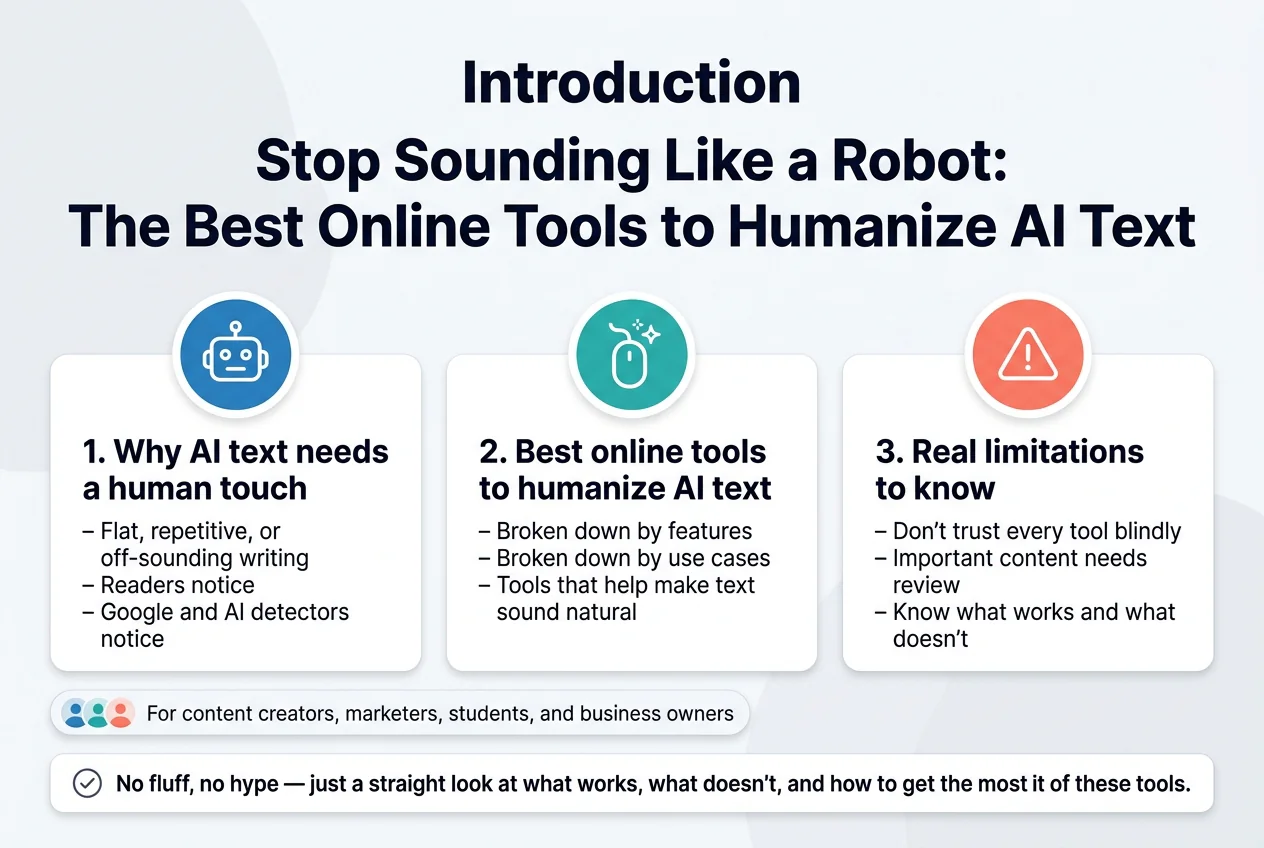
AI writing tools save time, but the output often reads flat, repetitive, or just a little off. Readers notice. So do Google and AI detectors.
If you’re a content creator, marketer, student, or business owner who uses AI to draft content, this guide is for you. You want writing that actually sounds like a person wrote it — not a language model running on caffeine.
Here’s what we’ll cover:
- Why AI text needs a human touch and what makes it sound robotic in the first place
- The best online tools to humanize AI text right now, broken down by features and use cases
- Real limitations you should know about before you trust any of these tools with important content
No fluff, no hype — just a straight look at what works, what doesn’t, and how to get the most out of these tools.
Why AI-Generated Text Needs a Human Touch
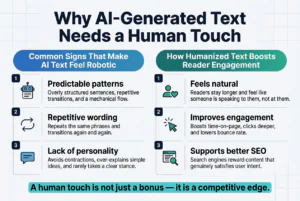
Common Signs That Make AI Text Feel Robotic
AI-written content often follows predictable patterns — overly structured sentences, repetitive transitions, and a strange lack of personality. It tends to over-explain simple ideas, avoids contractions, and rarely takes a clear stance. Readers pick up on this quickly, even if they can’t pinpoint exactly why something feels “off.” That’s where online tools to humanize AI text come in, helping strip away that mechanical tone and replace it with something that actually sounds like a real person wrote it.
How Humanized Text Boosts Reader Engagement
When writing feels natural, people stay longer, click deeper, and actually absorb what they’re reading. Humanized content creates a sense of connection — readers feel like someone is speaking to them, not at them. This directly improves engagement metrics like time-on-page and bounce rate, which search engines pay close attention to. Natural-sounding content also ranks better because Google rewards pages that genuinely satisfy user intent, not just ones packed with keywords. A human touch isn’t just a nice bonus — it’s a real competitive edge.
Key Features to Look for in an AI Text Humanizer Tool
A. Ability to Preserve Original Meaning and Intent
The best online tools to humanize AI text don’t just shuffle words around — they actually understand what your content is trying to say and keep that message intact. A good humanizer rewrites for flow and tone without accidentally changing facts, stripping context, or distorting your core argument. Always test a tool by running a passage with specific data points or nuanced claims to see if those survive the rewrite.
B. Natural Language Variation and Tone Adjustment
Strong tools introduce vocabulary diversity, sentence rhythm changes, and subtle tone shifts that mimic how real people actually write — not just synonym swaps. Look for options that let you choose a tone, whether casual, professional, or persuasive, so the output matches your audience without extra editing.
C. Bypass AI Detection While Maintaining Quality
A humanizer should reduce AI detection scores on tools like GPTZero or Originality.ai without making the text sound clunky or unnatural. Quality matters as much as detection bypass.
D. Support for Multiple Content Types and Formats
| Content Type | Why Format Support Matters |
|---|---|
| Blog posts | Needs SEO-friendly flow |
| Academic writing | Requires formal tone preservation |
| Marketing copy | Demands persuasive punch |
| Social media | Short, punchy rewrites needed |
Top Online Tools to Humanize AI Text
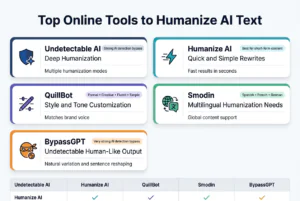
A. Undetectable AI for Deep Humanization
Undetectable AI is one of the most popular online tools to humanize AI text, and for good reason. It scans your content for AI patterns and rewrites it so thoroughly that even advanced detectors like GPTZero and Originality.ai struggle to flag it. You get multiple humanization modes — from subtle tweaks to aggressive rewrites — depending on how much transformation you need.
B. Humanize AI for Quick and Simple Rewrites
Humanize AI keeps things refreshingly simple. Paste your text, hit the button, and get a cleaner, more natural-sounding version back within seconds. It’s ideal for short-form content like social media posts, emails, or product descriptions where you need fast results without a complicated workflow.
C. QuillBot for Style and Tone Customization
QuillBot goes beyond basic paraphrasing. It lets you choose from writing modes like Formal, Creative, Fluent, and Simple, giving you real control over how the final text sounds. It’s a solid pick when you want your AI-generated draft to match a specific brand voice or audience.
D. Smodin for Multilingual Humanization Needs
Smodin stands out when you’re working across multiple languages. It supports rewriting in Spanish, French, German, and several other languages, making it a smart choice for global content teams who need consistent, human-sounding output regardless of the language.
E. BypassGPT for Undetectable Human-Like Output
BypassGPT is built specifically to produce text that flies under the radar of AI detection tools. It restructures sentence patterns, swaps predictable phrasing, and injects natural variation — the kind of subtle randomness that makes writing feel genuinely human rather than machine-generated.
| Tool | Best For | Multilingual | Detection Bypass |
|---|---|---|---|
| Undetectable AI | Deep humanization | Limited | ✅ Strong |
| Humanize AI | Quick rewrites | Limited | ✅ Moderate |
| QuillBot | Tone customization | ✅ Yes | Moderate |
| Smodin | Multilingual content | ✅ Yes | Basic |
| BypassGPT | Undetectable output | Limited | ✅ Very Strong |
How to Get the Best Results from Humanizer Tools
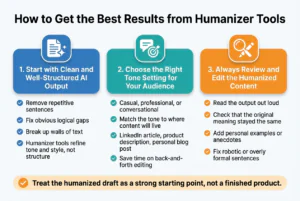
A. Start with Clean and Well-Structured AI Output
Before you paste anything into online tools to humanize AI text, take a moment to clean up your raw AI output. Remove repetitive sentences, fix obvious logical gaps, and break up walls of text into digestible chunks. Humanizer tools work best when the input is already organized — they refine tone and style, not structure. Garbage in, garbage out applies here just as much as anywhere else in writing.
B. Choose the Right Tone Setting for Your Audience
Most humanizer tools give you tone options like casual, professional, or conversational. Pick the one that matches where your content will live. A LinkedIn article needs a different voice than a product description or a personal blog post. Getting this setting right from the start saves you a lot of back-and-forth editing later.
C. Always Review and Edit the Humanized Content
- Read the output out loud — it helps catch awkward phrasing fast
- Check that your original meaning hasn’t shifted during transformation
- Add personal examples or anecdotes the tool couldn’t know about
- Fix any sentences that still feel robotic or oddly formal
No tool gets it perfect every time, so treat the humanized draft as a strong starting point, not a finished product.
Best Use Cases for AI Text Humanizer Tools
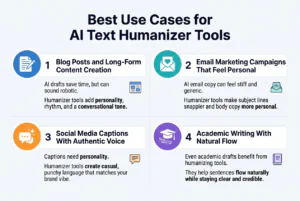
A. Blog Posts and Long-Form Content Creation
When you’re cranking out blog content at scale, AI drafts can save serious time — but they often read like a robot wrote them at 2 AM. Running those drafts through online tools to humanize AI text adds personality, varied sentence rhythm, and a conversational tone that keeps readers actually engaged. These tools work especially well for pillar content, how-to guides, and listicles where a warm, approachable voice builds trust with your audience faster than polished but robotic prose ever could.
B. Email Marketing Campaigns That Feel Personal
Nobody opens an email that feels like it was blasted from a corporate machine. AI-generated email copy tends to lean stiff and generic — exactly the opposite of what drives clicks. Humanizer tools smooth out that stiffness, making subject lines snappier and body copy feel like it’s talking to someone, not at them.
C. Social Media Captions With Authentic Voice
Captions need personality baked right in. A humanizer tool strips away the overly polished AI tone and injects casual, punchy language that matches your brand’s vibe — whether that’s witty, warm, or bold.
D. Academic Writing With Natural Flow
Even academic drafts benefit from humanizing tools, helping sentences flow naturally without sounding robotic or repetitive while keeping the content credible and clear.
Limitations to Be Aware of Before Using These Tools
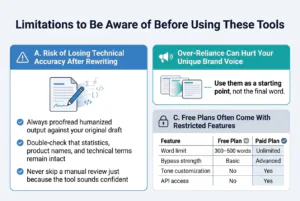
A. Risk of Losing Technical Accuracy After Rewriting
When you run technical or niche content through online tools to humanize AI text, the rewriting process can sometimes water down key details, swap out precise terminology, or slightly shift the meaning of a sentence. This is a real problem for industries like healthcare, law, or engineering where a single misplaced word can change everything.
- Always proofread humanized output against your original draft
- Double-check that statistics, product names, and technical terms remain intact
- Never skip a manual review just because the tool sounds confident
B. Over-Reliance Can Hurt Your Unique Brand Voice
If you run every piece of content through a humanizer without putting your own spin on it afterward, your writing can start sounding generic. These tools are trained on broad data patterns, so they naturally lean toward average, middle-of-the-road phrasing rather than something distinctly you.
Use them as a starting point, not the final word.
To Read more Aritcles this type Click Here
C. Free Plans Often Come With Restricted Features
Most free tiers cap your word count, skip advanced bypass modes, or slap a watermark on your output. Here’s a quick breakdown of what’s typically locked behind a paywall:
| Feature | Free Plan | Paid Plan |
|---|---|---|
| Word limit | 300–500 words | Unlimited |
| Bypass strength | Basic | Advanced |
| Tone customization | No | Yes |
| API access | No | Yes |
Concolusion:
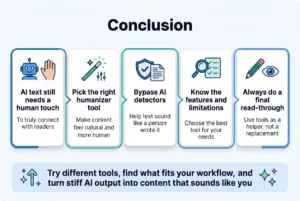
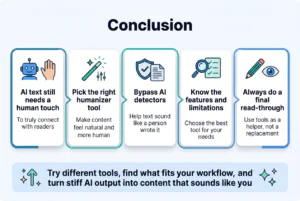
AI-generated text has come a long way, but it still needs that human touch to truly connect with readers. The right humanizer tool can make a real difference — helping your content feel more natural, bypass AI detectors, and actually sound like a person wrote it. From knowing what features to look for, to picking the best tool for your specific needs, the choices out there give you plenty of ways to clean up robotic-sounding text and make it work harder for you.
That said, no tool is perfect. Keeping an eye on the limitations and always giving your content a final read-through will save you from publishing something that still feels off. The sweet spot is using these tools as a helper, not a replacement for your own voice and judgment. Give a few of them a try, see which one clicks for your workflow, and start turning that stiff AI output into content that actually sounds like you.
To Read more Aritcles this type Click Here

-

 Solar Gadgets3 months ago
Crucial Fronus PV5200 Program Settings Explained
-

 Coding Tools3 months ago
Common Errors: “Out of Memory” fix
-

 Coding Tools2 months ago
How to Set Up Continue AI Offline?
-

 Solar Inverter3 months ago
How to Configure Your Solar Inverter Manual
-
 Solar Inverter2 months ago
How to set inverter for 24 hour backup
-

 Solar Gadgets2 months ago
7 Best Solar Powered Camping Gear 2026
Pingback: Ai Tools For Real Estate Agents - Techmatrixs