
Coding Tools
what are the best ai search monitoring tools?

The Best AI Search Monitoring Tools (And How to Pick the Right One)
Introducation:
What are the best AI search monitoring tools? Compare the top platforms to track your brand’s share of voice and sentiment in AI search.
If your brand shows up in AI-generated answers — or doesn’t — you need to know about it. Marketers, SEO professionals, and business owners are asking the same question right now: what are the best AI search monitoring tools, and which one actually fits their needs?
This guide breaks it down for you. You’ll learn what core features separate a solid tool from a weak one, get a clear look at the top options on the market today, and walk away knowing exactly how to compare them side by side.
Why AI Search Monitoring Tools Matter for Your Business
How AI is Changing the Way People Search Online
Search behavior has shifted dramatically. Instead of clicking through ten blue links, people now ask ChatGPT, Perplexity, Google’s AI Overviews, and similar tools to just give them the answer directly. These AI systems pull from a wide range of sources and package everything into a single, confident response — which means your brand either shows up in that response or gets left out completely.
The Growing Need to Track Brand Visibility in AI Search Results
When someone asks an AI “what’s the best project management software” or “which CRM should I use,” the tool that gets mentioned wins the consideration. Knowing whether your brand appears in those AI-generated answers — and how it’s described — is now a real business priority. That’s exactly where the best AI search monitoring tools come in, helping you track mentions, sentiment, and share of voice across AI platforms in real time.
Key Risks of Ignoring AI Search Monitoring
- Invisible to buyers: If AI tools never recommend your brand, potential customers may never discover you exist.
- Reputation blind spots: AI might describe your product inaccurately, and you won’t know without monitoring.
- Competitor advantage: Rivals who track AI visibility can adjust their content strategy faster, pulling ahead while you’re guessing.
Core Features to Look for in an AI Search Monitoring Tool
A. Real-Time Tracking of AI-Generated Search Results
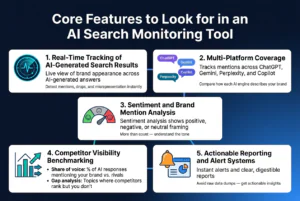
The best AI search monitoring tools give you a live view of how your brand appears across AI-generated answers — not just traditional blue links. You want to know the moment your brand gets mentioned, dropped, or misrepresented in an AI response.
B. Multi-Platform Coverage Across ChatGPT, Gemini, and Perplexity
- Tracks mentions across ChatGPT, Gemini, Perplexity, and Copilot
- Captures how differently each AI engine describes your brand
- Flags gaps where competitors appear but you don’t
C. Sentiment and Brand Mention Analysis
Good tools don’t just count mentions — they read the room. Sentiment analysis tells you whether AI platforms are framing your brand positively, negatively, or neutrally.
D. Competitor Visibility Benchmarking
| Feature | What to Expect |
|---|---|
| Share of voice | % of AI responses mentioning your brand vs. rivals |
| Gap analysis | Topics where competitors rank but you don’t |
E. Actionable Reporting and Alert Systems
When searching for the best AI search monitoring tools, prioritize platforms that deliver instant alerts and clear, digestible reports — not just raw data dumps you have to decode yourself.
Top AI Search Monitoring Tools Available Today
A. Overview of Leading Tools and What Sets Them Apart
When you’re asking what are the best AI search monitoring tools, the honest answer is that the right pick depends heavily on your workflow. Some tools shine at tracking brand mentions across AI platforms like ChatGPT, Perplexity, and Google AI Overviews, while others go deeper into citation analysis, competitor benchmarking, or prompt testing. The table below breaks down the most talked-about options right now:
| Tool | Key Strength | Best For |
|---|---|---|
| Brandwatch | Real-time AI mention tracking | Brand visibility |
| Semrush AI Toolkit | SEO + AI search integration | Organic search teams |
| Peec.ai | AI answer monitoring | Prompt-level insights |
| Rankscale | SERP + AI overview tracking | Technical SEO pros |
| Otterly.AI | Multi-platform AI visibility | Agencies |
Each tool takes a slightly different angle on the same core problem: understanding how your brand shows up when people search using AI.
B. Best Tools for Enterprise-Level Monitoring Needs
Enterprise teams need scale, customization, and reliable data pipelines. Brandwatch and Semrush are strong here because they handle massive keyword sets, offer API access, and play nicely with existing marketing stacks. Rankscale is worth checking out if you need granular tracking of AI Overviews alongside traditional SERP data.
- Deep historical data access
- Custom dashboards and reporting
- Role-based user permissions
- CRM and BI tool integrations
C. Best Budget-Friendly Options for Small Businesses
Small businesses don’t need to spend thousands to get useful AI search visibility data. Otterly.AI and Peec.ai both offer affordable entry points with surprisingly solid feature sets. You can track how often your brand or product appears in AI-generated answers without blowing your marketing budget.
- Otterly.AI: Simple setup, clean UI, great for beginners
- Peec.ai: Good prompt simulation and answer tracking
- Free tiers or low-cost plans available on both
D. Tools Best Suited for Agency and Multi-Client Use
Agencies managing multiple clients need tools that support white-labeling, bulk monitoring, and clean client reporting. Otterly.AI stands out here with its multi-client workspace setup. Semrush also works well at the agency level, especially if your team is already running SEO campaigns through the platform. Look for tools that let you:
- Manage separate client accounts from one dashboard
- Export branded PDF reports
- Set up automated alerts per client
- Track competitors across multiple industries simultaneously
How to Compare AI Search Monitoring Tools Effectively
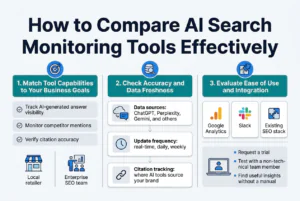
A. Matching Tool Capabilities to Your Specific Business Goals
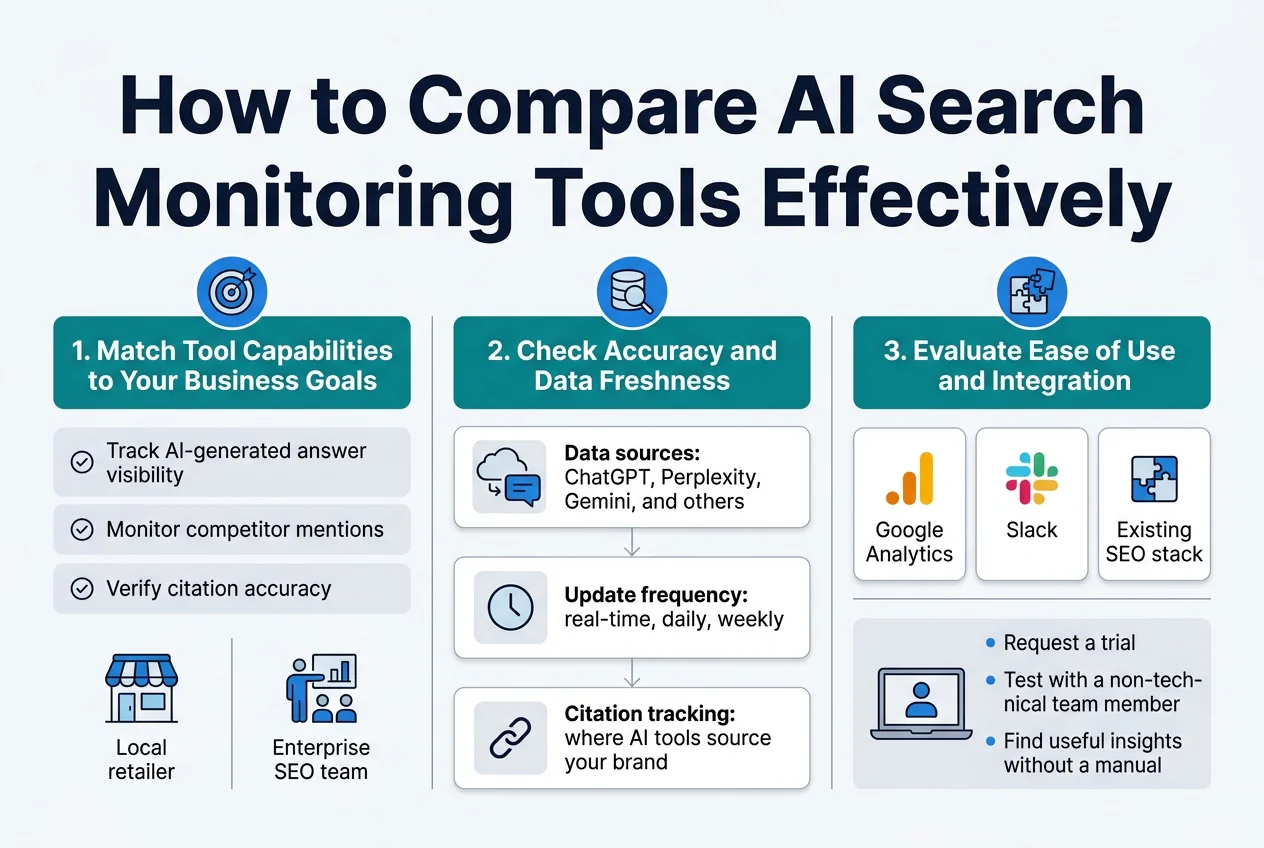
Before you start comparing what are the best AI search monitoring tools, get clear on what you actually need. A local retailer tracking brand mentions across AI answers has very different needs than an enterprise SEO team monitoring hundreds of keywords across multiple markets. Map your goals first — whether that’s tracking AI-generated answer visibility, competitor mentions, or citation accuracy — then shortlist tools that directly address those priorities rather than ones packed with features you’ll never touch.
B. Evaluating Accuracy and Data Freshness
| Factor | What to Check |
|---|---|
| Data sources | Does it pull from ChatGPT, Perplexity, Gemini, and others? |
| Update frequency | Real-time vs. daily vs. weekly refreshes |
| Citation tracking | Does it show where AI tools source your brand? |
C. Assessing Ease of Use and Integration with Existing Workflows
A tool that’s powerful but painful to use will collect dust. Check whether it plugs into platforms your team already uses — Google Analytics, Slack, or your existing SEO stack. Request a trial, put a non-technical team member in front of it, and see how quickly they find useful insights without needing a manual.
How to Get Maximum Value from Your AI Search Monitoring Tool
Setting Up Meaningful Tracking Goals and KPIs
Before you start pulling reports, get clear on what success actually looks like for your business. Are you tracking brand mentions in AI-generated answers?Define specific KPIs like:
- AI citation frequency – how often your brand appears in AI search results
- Share of voice – your visibility compared to competitors
- Content coverage gaps – topics where rivals show up but you don’t
Without clear goals, you’re just collecting data with no direction.
Using Insights to Optimize Your Content for AI Search
Once your tracking is running, look for patterns in which content gets cited by AI engines and which gets ignored. AI tools tend to favor content that directly answers questions, has clear structure, and demonstrates expertise. Use your monitoring data to rewrite thin pages, add FAQ sections, and target topics where competitors consistently outrank you in AI responses.
To Read more Aritcles this type Click Here
Monitoring Competitors to Uncover Growth Opportunities
Your competitors’ AI visibility is a goldmine of insight. When you notice a rival consistently appearing in AI answers for specific queries, dig into what their content does differently — format, depth, or freshness often make the difference.
To Read more Aritcles this type Click Here
Turning Data into Actionable SEO and Marketing Strategies
Raw data only becomes valuable when it shapes your next move. Schedule monthly reviews where your team translates monitoring insights into content briefs, campaign pivots, or outreach efforts targeting publications that AI tools frequently reference.
Conslusion:
Keeping tabs on how your brand appears in AI-generated search results is no longer optional — it’s quickly becoming a core part of any smart digital strategy. The right monitoring tool gives you a clear picture of where you stand, what’s being said about you, and where you can make improvements to stay competitive.
Start by nailing down what matters most to your business, whether that’s citation tracking, sentiment analysis, competitor benchmarking, or real-time alerts. From there, test a few tools, compare them honestly against your goals, and commit to actually using the insights they surface. The data is only as good as the action you take on it. Pick a tool that fits your workflow, and make AI search monitoring a regular habit — not just a one-time check.

-

 Solar Gadgets4 months ago
Crucial Fronus PV5200 Program Settings Explained
-

 Coding Tools4 months ago
Common Errors: “Out of Memory” fix
-

 Coding Tools4 months ago
How to Set Up Continue AI Offline?
-

 Solar Gadgets4 months ago
7 Best Solar Powered Camping Gear 2026
-
 Solar Inverter4 months ago
How to set inverter for 24 hour backup
-

 Solar Inverter4 months ago
How to Configure Your Solar Inverter Manual
Pingback: The Top 5 Key Coding Tools - Techmatrixs